
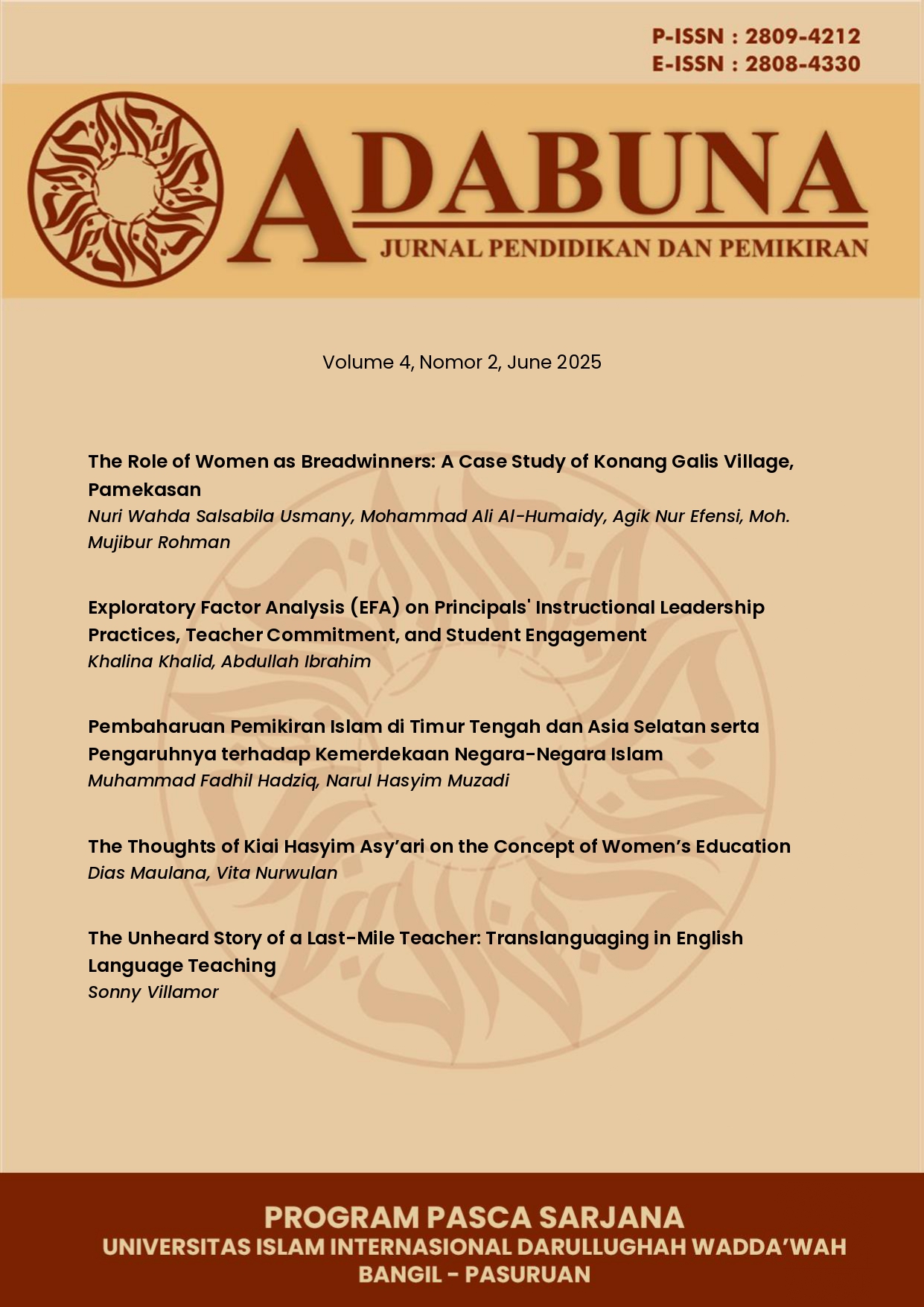
The Renewal of Islamic Thought in the Middle East and South Asia and Its Influence on the Independence of Islamic Countries
DOI:
https://doi.org/10.38073/adabuna.v4i2.2582Keywords:
Islamic Thought Renewal, Independence Movements, Islamic Reformism, Islamic Modernization, Pan-IslamismAbstract
The reform of Islamic thought in the Middle East and South Asia emerged as a response to colonialism and the challenges of modernity. Figures such as Jamaluddin Al-Afghani, Muhammad Abduh, Rashid Rida, Hassan Al-Banna, Sayyid Ahmad Khan, Abul A’la Maududi, Ali Shariati, and Muhammad Ali Pasha initiated religious reforms that significantly influenced the struggle for independence in the Islamic world. However, comparative studies on their contributions to independence movements in these two regions remain limited. This study aims to analyze the ideas of key Islamic reformers and examine their relevance in addressing contemporary challenges. Using a qualitative historical approach, this research explores how these reformers integrated Islamic teachings with modern advancements in education, governance, and law to resist colonialism. The findings show that Islamic reformers played a crucial role in shaping nationalist movements, reviving Islamic identity, and supporting the establishment of independent Muslim nations. Their advocacy for education, ijtihad (independent reasoning), and political unity formed the foundation of anti-colonial resistance. In conclusion, Islamic thought reform not only contributed to national independence but also continues to influence contemporary Islamic governance and social movements. This study offers valuable insights into the dynamic relationship between Islam, modernization, and political independence, and provides a basis for further research on the relevance of Islamic reformist thought in the modern era.
Downloads
References
Abbas, Shahzada Rahim. “Religion of Revolution: An Inquiry into Ali Shariati’s Redefinition of Islam as a Catalyst for Social and Political Change.” Preprint, SSRN, 2025. https://doi.org/10.2139/ssrn.5626972.
Ahmed, Tanjeel, and Muhammad Amin. “Nationalism, Patriotism and Political Ideas of Sir Syed Ahmad Khan: An Analysis.” International Journal Ihya’ ’Ulum al-Din 23, no. 2 (December 2021): 138–51. https://doi.org/10.21580/ihya.23.2.9263.
Aktürk, Şener. “One Nation under Allah? Islamic Multiculturalism, Muslim Nationalism and Turkey’s Reforms for Kurds, Alevis, and Non-Muslims.” Turkish Studies 19, no. 4 (August 2018): 523–51. https://doi.org/10.1080/14683849.2018.1434775.
Al Omari, Nayel Musa Shaker. “Rashid Rida’s Efforts in Calling for Muslim Unity and Political Reform.” Journal of Islam in Asia (E-ISSN: 2289-8077) 6, no. 1 (September 2009): 149–89. https://doi.org/10.31436/jia.v6i1.61.
Al-Haddad, Bujuna. “Muhamad Iqbal Dalam Konstribusi Pemikiran Dan Pembahuruan Islam Di India-Pakistan.” AL-Taddabur: Jurnal Kajian Sosial, Peradaban Dan Agama 8, no. 1 (2022).
Ali, Islam. “Muhammad Iqbal.” In Reappraising Modern Indian Thought: Themes and Thinkers, edited by Ankit Tomar and Suratha Kumar Malik, 317–46. Singapore: Springer Nature, 2022. https://doi.org/10.1007/978-981-19-1415-7_15.
Ali, Mohsin. “Muhammad Ali and Modernization of Egypt: Historical-Cultural Perspectives.” The International Journal of Humanities 30, no. 2 (March 2023): 42–53.
AlSamara, Kinda. “Muhammad ʻAbduh: Islam and New Urbanity in the Nineteenth-Century Arab World.” Australian Journal of Islamic Studies 3, no. 1 (June 2018): 63–79. https://doi.org/10.55831/ajis.v3i1.77.
Amin, Muhammad. “Implications of Ali Sharīatī’s Political Thought for Iranian Revolution.” Journal of Islamic Thought and Civilization 05, no. 02 (October 2015): 56–67. https://doi.org/10.32350/jitc.52.05.
Amir, Ahmad Nabil. “The Influence of Muhammad Abduh in The Nusantara: From Qur’anic Exegesis to Islamic Reform Movement.” Afkaruna: Indonesian Interdisciplinary Journal of Islamic Studies 18, no. 2 (December 2022): 260–78. https://doi.org/10.18196/afkaruna.v18i2.10282.
Amri, Yaser, Yogi Febriandi, and Phaison Da-Oh. “Religious Moderation Unveiled: The Intersection of Textual and Contextual Approaches to Understanding Indonesian Muslims.” MIQOT: Jurnal Ilmu-Ilmu Keislaman 48, no. 1 (June 2024). https://doi.org/10.30821/miqot.v48i1.1207.
Anas, Omair. “The Transition of Islamic Thought on Nation-States on the Indian Subcontinent.” In The Routledge International Handbook of Contemporary Muslim Socio-Political Thought. Routledge, 2021.
Anim, Sarbini. “Muhammad Iqbal And The Idea Of Dynamic Islam.” Al-Risalah 15, no. 1 (January 2024): 387–98. https://doi.org/10.34005/alrisalah.v15i1.3574.
Ansyary, Hafiz. Pembaharuan Islam Di Mesir. Yogyakarta: Bildung, 2023.
Assyaukanie, Luthfi. Ideologi Islam Dan Utopia. Jakarta: Freedomn Institute, 2011.
Azlan, Ariff Aizuddin. “Islam and Nationalism in the Thought of Jamal Al-Din Al-Afghani.” Journal of Islamic Thought and Civilization 12, no. 2 (December 2022): 212–24. https://doi.org/10.32350/jitc.122.15.
———. “Islam and Nationalism in the Thought of Jamal Al-Din Al-Afghani.” Journal of Islamic Thought and Civilization 12, no. 2 (December 2022): 212–24. https://doi.org/10.32350/jitc.122.15.
Belhaj, Abdessamad. “From Divine to Popular Sovereignty: The Civil Shift in Contemporary Islamic Political Thought.” Religions 16, no. 5 (May 2025). https://doi.org/10.3390/rel16050622.
Cici, Cici Cahyani and Banu Irfan. “History of Islamic Education in the Modernization Era of Egypt.” HISTORICAL: Journal of History and Social Sciences 1, no. 1 (November 2022): 15–20. https://doi.org/10.58355/historical.v1i1.29.
Cömert, Lokman. “Analyzing the Interaction between Islam and Ideology in the Political Thought of Hassan Al-Banna and Ayatollah Khomeini.” Turkish Journal of Shiite Studies 6, no. 1 (June 2024): 67–86. https://doi.org/10.48203/siader.1482105.
Dwi Sukmanila. “Kiprah Dan Kontribusi Jamaluddin Al-Afghani Dalam Pemukiran Modern Islam.” At-Tajdid, 2005.
Gani, Jasmine K. “Anti-Colonial Connectivity between Islamicate Movements in the Middle East and South Asia: The Muslim Brotherhood and Jamati Islam.” Postcolonial Studies 26, no. 1 (January 2023): 55–76. https://doi.org/10.1080/13688790.2023.2127660.
Ghaffari, Fathul, Khoirul Faizin, Ahmad Afif, Suud Sarim Karimullah, and Moh. Rosil Fathony. “The Relationship Between Religion and Politics of Muhammad Iqbal: A Philosopical and Its Relevance.” Suhuf 37, no. 1 (May 2025). https://doi.org/10.23917/suhuf.v37i1.10286.
Gojali, M. Imam, Imron Fauzi, and Khotibul Umam. “Modernism In Islamic Education In Tafsir Al-Manār: An Epistemological Review Of Muhammad Abduh And Muhammad Rashid Ridha.” LINGUA: Jurnal Bahasa, Sastra, Dan Pengajarannya 21, no. 1 (April 2024): 91–105. https://doi.org/10.30957/lingua.v21i1.921.
Gomaa, Omar. “Hassan Al-Banna and His Modern Political Islam.” International Journal of Social Science and Human Research 05, no. 08 (August 2022). https://doi.org/10.47191/ijsshr/v5-i8-04.
Gumilar, Setia, and Firman Maulana Noor. “Hasan Al-Banna and Ikhwanul Muslimin’s Da’wah Movement in Egypt.” Ilmu Dakwah: Academic Journal for Homiletic Studies 16, no. 2 (December 2022): 397–414. https://doi.org/10.15575/idajhs.v16i2.20982.
Gunn, Simon, and Lucy Faire. Research Methods for History. Research Methods for the Arts and Humanities Series. United States: Edinburgh University Press, 2011.
Hajjaj, Bobby. “Nationalism and National Identity Formation in Bangladesh: A Colonial Legacy behind the Clash of Language and Religion.” Asian Journal of Comparative Politics 7, no. 3 (September 2022): 435–48. https://doi.org/10.1177/2057891120938145.
Hamid, Nirwan. “Pembaharuan Islam Di India.” Al-Tadzkiyyah: Jurnal Pendidikan Islam 7 (2016): 63–83.
Hamim, Khairul, and M Masykur Abdillah. “Renaissance of Islam: A Content Analysis of Muhammad Rashīd Riḍā’s Exegesis.” Journal of Islamic Thought and Civilization 13, no. 2 (December 2023): 104–19. https://doi.org/10.32350/jitc.132.07.
Harahap, Sumper Mulia. Khilafah Konstitusional Dalam Pemikiran Politik Islam Rasyid Ridha. 2014, 1–25.
Hashas, Mohammed. Contemporary Moroccan Thought. Brill, 2024. https://brill.com/display/title/63015.
Hasneli, Hasneli, Meirison Meirison, and Qasem Muhammadi. “Educational Renewal During Muhammad Ali Period and Its Impact on The Al-Azhar Educational Institution.” Tafkir: Interdisciplinary Journal of Islamic Education 5, no. 1 (January 2024): 27–40. https://doi.org/10.31538/tijie.v5i1.687.
Hirzi, Muhammad Hilman. “Transformation of Islamic Nationalism into Pancasila Nationalism: Dynamics of Islamic Unity Nationalist Thought.” International Journal of Islamicate Social Studies 3, no. 1 (May 2025): 81–90. https://doi.org/10.62039/ijiss.v3i1.64.
Hussain, Adeel. “Muhammad Iqbal’s Constitutionalism.” Indian Law Review 2, no. 2 (May 2018): 135–58. https://doi.org/10.1080/24730580.2018.1544023.
Hussain, Dr. Ishtiaq. “Revisiting a Fractured Legacy: Sir Syed Ahmed Khan and Muslim Women Education.” Rashhat-e-Qalam 2, no. 2 (September 2022): 85–100. https://doi.org/10.56765/rq.v2i2.74.
Hussain, Syed Rafaqat, and Mazher Hussain. “Politico-Religious Thoughts Of Shah Waliullah (1703-1762) And Abul Aala Maududi (1903-1979): A Comparative Study.” Journal of Academic Research for Humanities (Pakistan) 4, no. 2 (2024): 211.
Irfan, Muhammad, and Astuti Purwasari. “From Taqlid to Inclusion: The Transformation of Islamic Education During the Islamic Renewal in Egypt.” Journal Analytica Islamica 14, no. 2 (July 2025): 684–701. https://doi.org/10.30829/jai.v14i2.25039.
Istadiyantha. “Pengaruh Pemikiran Ulama Timur Tengah Terhadap Gerakan Islam Politik Di Yogyakarta Dan Surakarta.” Center of Middle Eastern Studies (CMES): Jurnal Studi Timur Tengah 6, no. 1 (2013): 65–76.
Jaelani, Juhri. “Modernitas Kehidupan Beragama Dalam Perkembangan Pendidikan Islam (Studi Analisis Pemikiran Muhammad Abduh).” Civilization Research: Journal Of Islamic Studies, 2, no. 1 (2023).
Kauser, Dr Yasmeen, Dr Shagufta Firdous, and Dr Irum Saba. “Dr. Saeed Akhtar Durrani’s Iqbal Studies : (Antiques in Europe in the Context of Iqbal).” Negotiations 4, no. 2 (December 2024): 201–9.
Kemper, Michael. From Regional Islamic Reform to Global Anti-Colonialism? Jamaladdin al-Afghani and Russia’s Muslims. November 6, 2024. https://doi.org/10.1163/27728668-20240029.
Khanafi, Ade Firman, Syamsul Arifin, and Fahrudin Mukhlis. “Muhammad Iqbal’s Islamic Education Philosophy: Critical Analysis Mbkm Curriculum.” Kanz Philosophia: A Journal for Islamic Philosophy and Mysticism 11, no. 1 (June 2025): 1–20. https://doi.org/10.20871/kpjipm.v11i1.390.
Kurdi, Sulaiman. “Jamaluddin Al-Afghani Dan Muhammad Abduh (Tokoh Pemikir Dan Aktivis Politik Di Dunia Islam Modern).” Syariah Jurnal Hukum Dan Pemikiran 15, no. 1 (August 2015). https://doi.org/10.18592/syariah.v15i1.541.
Kuru, Ahmet T. “Islamism and Nationalism: How Did Old Enemies Become New Allies?” Zeitschrift Für Religion, Gesellschaft Und Politik, ahead of print, November 8, 2024. https://doi.org/10.1007/s41682-024-00186-3.
Liky Faizal, Abd. Qohar, and Ali Abdul Wakhid. “Telaah Pemikiran Ali Sya’riati Tentang Pemerintah Islam Kontemporer.” Jurnal Tapis: Teropong Aspirasi Politik Islam 18, no. 1 (2022): 27–41.
Lubis, M. Ridwan. “Pembaharuan Pemikiran Islam : Dasar,Tujuan, Dan Masa Depan.” Ilmu Ushuluddin 5, no. 2 (20116): 223–46.
Mohomed, Carimo. “‘Islam’ as the National Identity for the Formation of Pakistan: The Political Thought of Muhammad Iqbal and Abu’l ’Ala Mawdudi.” História (São Paulo) 33, no. 1 (June 2014): 317–39. https://doi.org/10.1590/S0101-90742014000100015.
Moqadam, Mahbubeh. “Ali Shariati and Crafting a Collective Revolutionary Islamic Identity for Women: A Socio-Historical Perspective.” Journal of Asian and African Studies 60, no. 3 (May 2025): 1943–57. https://doi.org/10.1177/00219096231207891.
Noor, Salafuddin, Ahmadi Hasan, and Nuril Khasyi’in. “Review of Political Theory of Islamic Law Abul ’Ala Al Maududy Positive Perspective of the Political System of Indonesian Islamic Law.” Syariah: Jurnal Hukum Dan Pemikiran 23, no. 1 (June 2023): 36–49. https://doi.org/10.18592/sjhp.v23i1.9626.
Prayogi, Arditya. “Telaah Konseptual Pendekatan Kuantitatif Dalam Sejarah.” Kalpataru: Jurnal Sejarah Dan Pembelajaran Sejarah 8, no. 1 (August 2022). https://doi.org/10.31851/kalpataru.v8i2.8970.
Rasheed, Shahid and Department of Islamic Thought and Civilization, University of Management and Technology, Lahore, Pakistan. “Discourse on Nationalism: Political Ideologies of Two Muslim Intellectuals, Maulana Hussain Ahmad Madani and Allama Muhammad Iqbal.” Journal of Islamic Thought and Civilization 09, no. 02 (December 2019): 127–47. https://doi.org/10.32350/jitc.92.07.
Rohmah, Siti, Moh Anas Kholish, and Andi Muhammad Galib. “Human Rights and Islamic Law Discourse: The Epistemological Construction of Abul A’la Al-Maududi, Abdullahi Ahmed An-Naim, and Mashood A. Baderin.” Justicia Islamica 19, no. 1 (July 2022): 153–70. https://doi.org/10.21154/justicia.v19i1.3282.
Ruhullah, Mohammad Eisa, and Thameem Ushama. “Islamic Epistemology in the Bangladesh Government System (1996–2022): An Analysis of Political Ideologies.” Jurnal Bina Praja 15, no. 3 (December 2023): 479–93. https://doi.org/10.21787/jbp.15.2023.479-493.
Saeidi, Fateh, and Davoud Osmanzadeh. “Colonial Sovereignty and Religious Necropolitics: The Sacred Victimization of Infidel Kurds in the Middle East.” Ethnicities 25, no. 5 (October 2024): 655–78. https://doi.org/10.1177/14687968241287204.
Saleh Nur. Abdul Kalam Azad: Nasionlisme India. 12, no. 2 (2015).
Situmoraang, Jubair. Pembaharuan Pemikiran Rasyid Ridha Di Berbagai Bidang (Pendidikan, Agama, Dan Politik). Malang: Literasi Nusantara Abadi, 2022.
Syafieh, Syafieh, and M. Anzhaikan. “Moderate Islam And Its Influence on Religious Diversity in Indonesia.” ESENSIA: Jurnal Ilmu-Ilmu Ushuluddin 23, no. 2 (March 2023). https://doi.org/10.14421/esensia.v23i2.3262.
Ulfah, Novi Maria. “Sejarah Dan Strategi Dakwah Ikhwanul Muslimin.” Smart 2, no. 2 (2016): 213. https://doi.org/10.18784/smart.v2i2.397.
Young, Benjamin R. “‘Even They Might Rise’: The Islamic Republic of Iran’s Solidarity with African Americans.” The Journal of African American History 109, no. 4 (September 2024): 569–91. https://doi.org/10.1086/732139.
Zaman, Arshad. “Maulānā Maudūdī and the Genesis of Islamic Economics.” Turkish Journal of Islamic Economics 8, no. 2 (August 2021): 597–622. https://doi.org/10.26414/A036.
Downloads
Published
How to Cite
Issue
Section
License
Copyright (c) 2025 Muhammad Fadhil Hadziq, Narul Hasyim Muzadi

This work is licensed under a Creative Commons Attribution-ShareAlike 4.0 International License.