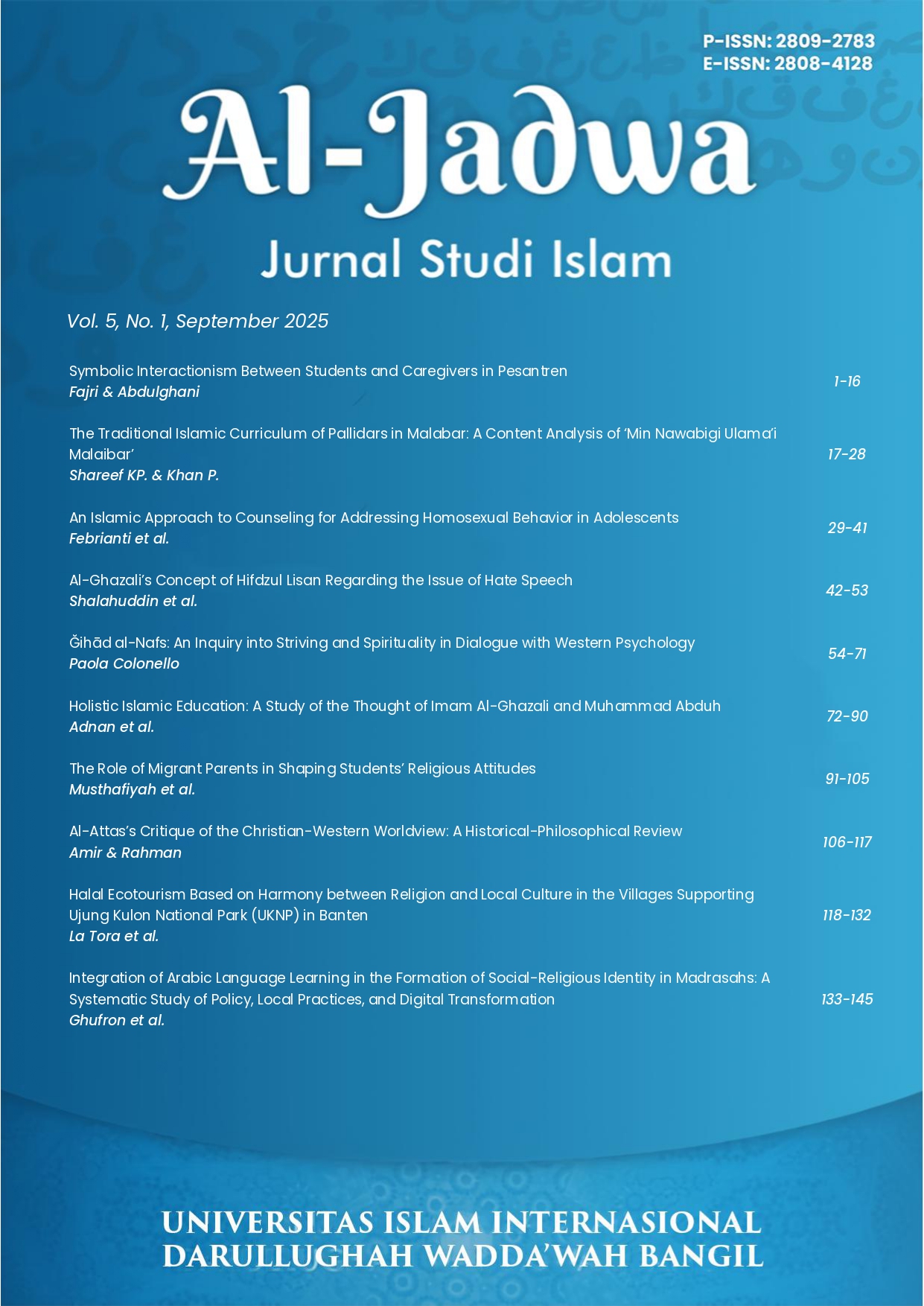
The Traditional Islamic Curriculum of Pallidars in Malabar: A Content Analysis of ‘Min Nawabigi Ulama’i Malaibar’
DOI:
https://doi.org/10.38073/aljadwa.3316Keywords:
Islamic Education, Malabar, Pallidars, Curriculum, Content AnalysisAbstract
The Muslim community of Malabar, South India has placed significant emphasis on Islamic education since the advent of Islam into the land. In order to impart Islamic education, Muslims of Kerala instituted different systems such as Ottupalli (kuttab, for basic learning of Islamic teachings), Pallidars (Mosque Centered Higher Learning System) in medieval periods. The article is a detailed academic study on the traditional Islamic curriculum of Pallidars in Malabar, focusing on the content analysis of the book ‘Min Nawabigi Ulama’i Malaibar’ by Sayyid Abdu-Rahman Al Azhari. It explores the historical evolution of Islamic education in Malabar, the significance of Pallidars as mosque-based educational institutions, and the curricula that shaped traditional religious education in the region. Key findings include the identification of three distinct curricula—Ma'bari, Fakhriyya, and Nizamiya—and their historical relevance. The study also highlights the flexibility and accessibility of the curriculum of Pallidars education, its connection to global Islamic learning centers and its impact in shaping the curriculum. It emphasizes the need for further research into the medieval curriculum and its impact on contemporary Islamic education in Malabar.
Downloads
References
Abraham, Jose. “Contributions to Educational Reform.” In Islamic Reform and Colonial Discourse on Modernity in India, by Jose Abraham. Palgrave Macmillan US, 2014. https://doi.org/10.1057/9781137378842_4.
Ahmad Amir Aziz and Miftahul Huda. “Contribution of Islamic University to Development of Mosque-Based Non-Formal Islamic Education in Lombok Indonesia.” Al-Hayat: Journal of Islamic Education 8, no. 3 (2024): 982–98. https://doi.org/10.35723/ajie.v8i3.677.
Akrim, A., Hasrian Rudi Setiawan, Selamat Selamat, and Nurman Ginting. “Transformation of Islamic Education Curriculum Development Policy in the National Education System.” Cypriot Journal of Educational Sciences 17, no. 7 (2022): 2538–52. https://doi.org/10.18844/cjes.v17i7.7685.
Alamin, Nurul Salis, Zakiya Setyo Rahmawati, Marheni Br Maha, Shofiyyatun Nisa, and Ahmad Zalzuli. “Hidden Curriculum In Students’ Activities At Modern Islamic Boarding School: Phenomenology Study at Darussalam Gontor Islamic Boarding School, Ponorogo, East Java.” MIQOT: Jurnal Ilmu-Ilmu Keislaman 48, no. 1 (2024): 57–72. https://doi.org/10.30821/miqot.v48i1.1134.
Anas Edoli. “Shāfiʿī School of Jurisprudence: Circulation and Mobility across the Indian Ocean Region.” ISLAMIC INSIGHT 1 1, no. 2 (2018): 65–77.
Arbain Nurdin, Hendra, Khozin, Abdul Haris, Nurul Zainab, and Mohammad Zaini Yahaya. “Developing the Islamic Religious Education Curriculum in Inclusive Schools or Madrasah and Its Implementation: A Systematic Literature Review.” Jurnal Pendidikan Agama Islam 21, no. 1 (2024): 94–110. https://doi.org/10.14421/jpai.v21i1.6907.
Bahri, Wawan Saepul, Muhammad Zuhdi, and Suparto Suparto. “Integrating Naqli and Aqli Science in Islamic Education: Toward a Comprehensive Learning Model.” J-PAI: Jurnal Pendidikan Agama Islam 11, no. 2 (2025). https://doi.org/10.18860/jpai.v11i2.31447.
Basheer, K. Mohammed. Quality Enhancement in Madrasa Education: An Exploratory Study. 1st ed. Cambridge Scholars Publishing, 2016.
CK Abdurahman Faizy. Palli Dars: Charithram, Varthamanam (Palli Dars: Past and Present). 1st ed. Book Plus, 2024.
Dr. Thajudeen A.S. & Noushad V. The Role of Arabic Colleges in the Development of Literature and Culture in South Kerala. Project Pl.A/5466/UGC.XI.VII/Arabic/NRA/12. University of Kerala, 2014.
Huda, Miftachul, Abu Zarrin Selamat, and Sultan Salem. “Investigating Respect in Learning as Character Education: A Review of al-Zarnūjī’s Ta‘līm al-Muta‘allim.” Nazhruna: Jurnal Pendidikan Islam 7, no. 2 (2024): 209–32. https://doi.org/10.31538/nzh.v7i2.4187.
Ibrahim Badhusha. “From Arabia to Kerala: Tracing the Early Transmission of Islamic Knowledge.” HISTORICAL: Journal of History and Social Sciences 4, no. 2 (2025): 216–27. https://doi.org/10.58355/historical.v4i2.189.
Istiyani, Dwi, A. M. Wibowo, Mulyani Mudis Taruna, Titik Rahmawati, and Nugroho Eko Atmanto. “Challenges and Opportunities in Early Childhood Religious and Moral Education: A Perspective from the Evaluation of Logical Models.” Nazhruna: Jurnal Pendidikan Islam 7, no. 2 (2024): 233–49. https://doi.org/10.31538/nzh.v7i2.4843.
Jafar Paramboor and Mohd Burhan Ibrahim. “Islamic Higher Educational Institutions in a Secular Country: South Indian Lessons of Systemic Survival.” ISLAMIC INSIGHT 1, no. 1 (2018): 103–23.
Junaidi, Afrinaldi, Febria Sri Artika, Mohammad Omar Al-Momani, and Halad Hulwana. “Islamic Moderatism in Curriculum Development Of Islamic Educational Institutions in Aceh.” Jurnal Pendidikan Agama Islam 22, no. 1 (2025): 43–56. https://doi.org/10.14421/jpai.v22i1.8313.
Karim, Abdul. “Integration of Religious Awareness in Environmental Education.” QIJIS (Qudus International Journal of Islamic Studies) 10, no. 2 (2022): 415–42. https://doi.org/10.21043/qijis.v10i2.14404.
Koduvayakkal, Unais. “Indian Madrasahs: Evolution and Growth With Special Reference to Kerala Model.” Akademik Platform İslami Araştırmalar Dergisi 5, no. 2 (2021): 188–217. https://doi.org/10.52115/apjir.947587.
Kottaparamban, Musadhique. “Sea, Community and Language: A Study on the Origin and Development of Arabi- Malayalam Language of Mappila Muslims of Malabar.” Muallim Journal of Social Science and Humanities, October 2, 2019, 406–16. https://doi.org/10.33306/mjssh/31.
Kunnakkadan, Muhammed Unais, Nadzrah Ahmad, and Nashwan Abdo Khaled. “The Relevance of Tafsīr Al-Jalālayn among the Muslims of Malabar.” Al-Burhan: Journal of Qurʾān and Sunnah Studies 4, no. 1 (2020): 14–30.
Lili Sholehuddin Badri and Ahmed Abdul Malik. “Implementation of Islamic Education Values in Building Students’ Religious Character through an Affective Approach Based on the Qur’an.” Jurnal Pendidikan Agama Islam 21, no. 1 (2024): 217–33. https://doi.org/10.14421/jpai.v21i1.7260.
Logan, William. Malabar. Facsim. ed. Asian educational services, 1989.
M. Amin Abdullah. “From Dialogue to Engagement: Experiences of Civil Society Organizations in Religious Literacy Programs for Multicultural Education Curriculum in Indonesia.” Jurnal Pendidikan Agama Islam 21, no. 2 (2023): 264–74. https://doi.org/10.14421/jpai.v21i2.10234.
Ma’arif, Samsul, Ahmadi Ahmadi, Dzikrulloh Dzikrulloh, and Naily El Muna. “Pesantren Entrepreneurship: Harmonization of the Theories of Kasb Asy’ariyah and Locus of Control on Strengthening Santripreneur.” QIJIS (Qudus International Journal of Islamic Studies) 11, no. 1 (2023): 31–64. https://doi.org/10.21043/qijis.v11i1.17404.
Masturin, Masturin. “The Power of Two Learning Strategy in Islamic Religious Education Material Shaping Character Student.” Nazhruna: Jurnal Pendidikan Islam 7, no. 2 (2024): 250–69. https://doi.org/10.31538/nzh.v7i2.4678.
Masturin, Masturin, Mhd Rasid Ritonga, and Siti Amaroh. “Tawhid-Based Green Learning in Islamic Higher Education: An Insan Kamil Character Building.” QIJIS (Qudus International Journal of Islamic Studies) 10, no. 1 (2022): 215–52. https://doi.org/10.21043/qijis.v10i1.14124.
Mohammed, U. Educational Empowerment of Kerala Muslims: A Socio-Historical Perspective. Indian Council of Historical Research, 2007.
Moslimany, Raqib, Anzar Otaibi, and Frugo Shaikh. “Designing a Holistic Curriculum: Challenges and Opportunities in Islamic Education.” Journal on Islamic Studies 1, no. 1 (2024): 52–73. https://doi.org/10.35335/beztg009.
Mustofa, Moh Ayyub, and Fawaidur Ramdhani. “Islamic Education and Contemporary Challenges.” Adabuna: Jurnal Pendidikan Dan Pemikiran 2, no. 2 (2023): 109–27. https://doi.org/10.38073/adabuna.v2i2.1156.
Nadhif Muhammad Mumtaz, Evi Muafiah Alghani, and Doli Witro. “Educational Policy Analysis: Examining Pesantren Policies and Their Implications on the Independence of Kyai and Pesantren in the Contemporary Era.” Jurnal Pendidikan Agama Islam 21, no. 2 (2024): 287–306. https://doi.org/10.14421/jpai.v21i2.9612.
PA Saidu Muhammed. Kerala Muslim Charitram (History of Kerala Muslim). Al -Huda Book stall, 1996.
Parakkallil, Ibrahim Badhusha. “An Intellectual Legacy: Chalilakath Kunjahammed Haji’s Role in Modernizing Madrasa Education.” Al-Fadlan: Journal of Islamic Education and Teaching 3, no. 1 (2025): 127–36. https://doi.org/10.61166/fadlan.v3i1.90.
Qasmi, Muhammadullah Khalili. Madrasa Education: Its Strength and Weakness. 1st ed. With Markazul Ma’arif Education and Research Centre (Mumbai, India). MMERC ; Manak Publications, 2005.
S, Sumarni, Neng Aisyah, Abdurrahmansyah, and Tutut Handayani. “Urgency of Multicultural Islamic Education on Modern Indonesian Education.” Al-Jadwa: Jurnal Studi Islam 3, no. 2 (2024): 2. https://doi.org/10.38073/aljadwa.v3i2.1551.
Salim, Nur Agus, Mohammad Zaini, Abd Wahib, Imron Fauzi, and Asnawan Asnawan. “Fostering Moderate Character of Santri: Effective Hidden Curriculum Strategy in Islamic Boarding Schools.” Nazhruna: Jurnal Pendidikan Islam 7, no. 2 (2024): 357–72. https://doi.org/10.31538/nzh.v7i2.4676.
Sarbini, Sarbini, Tahrir Tahrir, Endi Endi, Salami Mutiu Olagoke, Setia Gumilar, and Mursidin Mursidin. “The Character Education Model as a Strategic Framework for Nurturing Religious Moderation Within State Islamic Higher Education Institutions in Indonesia.” QIJIS (Qudus International Journal of Islamic Studies) 13, no. 1 (2025): 1–38. https://doi.org/10.21043/qijis.v13i1.30618.
Sayyid Abdurahman Alaidarusi Al Azhari. Min Nawabigi Ulama’i Malaibar. Matabi al Bayan Atijariya, 1993.
Shafeeq Al-Hudawi. “Evolving Trends in the Curriculum of Higher Level Islamic Education in Kerala: An Appraisal from Social Engagement Perspective.” First Annual Malabar Praxis Graduate Research Conference, December 17, 2013, 1–24. https://ssrn.com/abstract=2368649.
Sharafuddin K.V. “History of Religious Organisations and Ideological Conflicts among the Muslims of Malabar from 1921-1989.” PhD, University of Calicut, 2022.
Sholeh, Muh Ibnu Sholeh, Habibur Rohman, Eko Agus Suwandi, Akhyak, Nur Efendi, and As’aril Muhajir. “Transformation Of Islamic Education: A Study Of Changes In The Transformation Of The Education Curriculum.” Jurnal Pendidikan Agama Islam 20, no. 1 (2023): 39–56. https://doi.org/10.14421/jpai.v20i1.6770.
Sholeh, Muh Ibnu Sholeh, Habibur Rohman, Eko Agus Suwandi, Akhyak, Nur Efendi, and As’aril Muhajir. “Transformation Of Islamic Education: A Study Of Changes In The Transformation Of The Education Curriculum.” Jurnal Pendidikan Agama Islam 20, no. 1 (2023): 39–56. https://doi.org/10.14421/jpai.v20i1.6770.
Subhan, Subhan, Zaki Ghufron, Mufrodi Mufrodi, and Mohamad Khaidir Bin Sahid. “Towards a Tawhidic Framework in Islamic Higher Education Curriculum: A Comparative Study of Indonesia and Malaysia.” QIJIS (Qudus International Journal of Islamic Studies) 12, no. 2 (2024): 333–70. https://doi.org/10.21043/qijis.v12i2.28676.
Suud Sarim Karimullah. “The Role of Mosques as Centers For Education and Social Engagement in Islamic Communities.” Jurnal Bina Ummat: Membina Dan Membentengi Ummat 6, no. 2 (2023): 151–66. https://doi.org/10.38214/jurnalbinaummatstidnatsir.v6i2.184.
Syukri, Syukri, Sulaiman Muhammad Amir, Fitriani Fitriani, and Sarmalina Pane. “Integration of Islamic Values with Environmental Ethics in Pesantren Education: A Case Study at Darularafah Raya Pesantren.” Jurnal Pendidikan Islam 13, no. 1 (2024): 1–12. https://doi.org/10.14421/jpi.2024.131.1-12.
Zainal Arifin, Thifal Khansa Nabila, Sri Rahmi, and Atika. “Organization of Islamic Education Curriculum to Prevent Radicalism Among Students in Indonesian Universities.” Jurnal Pendidikan Agama Islam 22, no. 1 (2025): 81–96. https://doi.org/10.14421/jpai.v22i1.8316.
Zaini, Achmad. “Modernizing Islamic Education in the Most Populated Muslim World.” Journal of Indonesian Islam 16, no. 1 (2022): 175. https://doi.org/10.15642/JIIS.2022.16.1.175-196.
Downloads
Published
How to Cite
Issue
Section
License
Copyright (c) 2025 Hassan Shareef KP, Shebeeb Khan P

This work is licensed under a Creative Commons Attribution-ShareAlike 4.0 International License.